
Am I Too Old For Blocks?

One of my lasting memories of athletics training as a kid was the excitement whenever old Pete, our coach, wheeled the wheelbarrow out of the shed filled with rusty starting blocks.
The blocks themselves were nothing special. Most had seen better days long before we got our hands on them. To us, though, they made us feel like real sprinters.
Back then, nobody was looking for reasons not to use blocks.
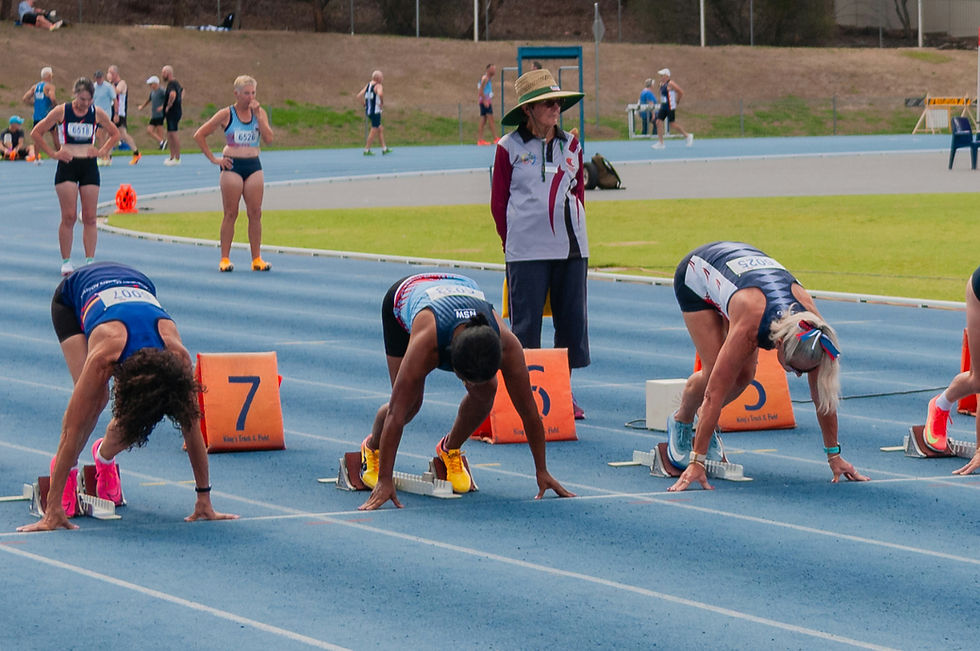
These days, one of the more common questions I hear from Masters athletes is whether they should stop using them altogether.
"Do you reckon I should switch to a three-point start this year?"
Other times it's hidden behind comments about stiff hips, awkward set positions or starts that simply don't feel the way they used to. The wording changes, but the question is usually the same:
Am I too old for blocks?
What makes the question interesting is that it often directs athletes towards the wrong problem.
When athletes ask whether they're too old for blocks, I'm usually thinking about acceleration. More specifically, I'm thinking about the physical qualities that underpin acceleration.
Because the athletes asking this question are rarely unable to sprint. More often, they're still capable of running well once they're upright and moving. The problem seems to exist during the first few steps of the race, before sprinting has really begun.
One of the more consistent observations I've made over the years is that athletes rarely describe the issue as a loss of speed. Instead, they describe how the start feels. They talk about feeling rushed, stuck or awkward. Often they describe a sensation where they're working harder to get out yet somehow generating less momentum. Some say they feel as though they're spinning their wheels during the first few steps, while others talk about standing up too early or feeling like a baby giraffe trying to find its feet.
Those descriptions matter because they often point towards a different conversation than simply whether an athlete is too old for blocks.
A block start is ultimately an acceleration task. Before an athlete can run fast, they first need to overcome inertia and project themselves forwards. The first few steps are about building momentum, not simply creating movement.
Looking at our own athlete data, one pattern appears more frequently than many people realise. As athletes search for a better start, there is often a tendency to become increasingly focused on stride frequency during acceleration. The legs begin moving faster, ground contacts become quicker and there is a visible effort to create speed through turnover.
The intention makes perfect sense. If acceleration no longer feels as powerful as it once did, moving the legs faster can feel like a logical solution.
The problem is that acceleration is not simply a race to move the legs quickly.
Acceleration is a process of applying force into the track and projecting the body forwards step by step. During the early stages of acceleration, momentum is still being created. Effective acceleration is not a sudden switch from pushing to running. It is a gradual transition between the two.
What we often see, however, is athletes becoming preoccupied with frequency before sufficient momentum has been established. In simple terms, they start trying to run before they have finished accelerating. The push back into the track gradually disappears, posture rises too quickly and the opportunity to continue building momentum is lost.
Part of the reason this happens almost certainly lies in the physical qualities that underpin acceleration.
Research consistently shows that strength, power and rate of force development become harder to maintain as we age. Ground contact times tend to increase and the ability to generate force rapidly often declines, even amongst highly trained athletes.
From a coaching perspective, this creates an understandable response. When athletes can no longer produce force quite as effectively as they once could, chasing frequency can feel like a reasonable solution. If pushing isn't producing the same result, moving faster seems like the obvious alternative.
The problem is that acceleration still depends on force production. No amount of leg speed can fully compensate for a loss of momentum during the early steps of a sprint.
This is one reason I think discussions around blocks sometimes miss the real issue.
Athletes often ask whether they're too old for blocks when a more useful question might be whether they still possess the physical qualities required to use blocks effectively.
Strength matters, power matters and the ability to produce force quickly matters. Not because those qualities somehow make an athlete younger, but because they underpin the ability to accelerate effectively. As athletes get older, maintaining those qualities often requires more deliberate attention than it once did.
Mobility deserves a mention as well, although perhaps not in the way many athletes expect.
There is no doubt that restrictions around the ankles, hips or thoracic spine can make effective start positions harder to achieve. Genuine mobility limitations exist and, when present, can influence acceleration mechanics.
At the same time, being able to reach a position and being able to produce force from that position are not the same thing. I've seen athletes with relatively modest mobility produce excellent starts because they possess the strength and power to use the ranges available to them effectively. I've also seen athletes with impressive mobility struggle to create momentum because they lack the force-producing capacity to take advantage of those positions.
Mobility matters, but it rarely acts alone. In many cases, the conversation is less about creating more range and more about improving what an athlete can do with the range they already have.
Which brings us back to the original question - Are you too old for blocks? In most cases, probably not.
I've seen athletes well into Masters competition continue to use blocks effectively. What tends to separate those athletes is not necessarily their age, but their ability to maintain the qualities that support acceleration.
We do have to acknowledge that block starts ask a lot of the body. As we get older, maintaining the strength, power and force-production characteristics required for effective acceleration often demands more attention than it once did.
But that's very different from saying blocks are no longer an option.
When athletes ask whether they're too old for blocks, I rarely think about age. I find myself thinking about acceleration, strength, power and the ability to create momentum. Age influences all of those qualities, but it doesn't determine them.
And that's why the most useful question usually isn't whether you're too old for blocks. It's whether you're doing enough to maintain the qualities that allow you to use them effectively.


Comments